Travel Guide · Cultural Triangle
Kandy & the Temple of the Sacred Tooth
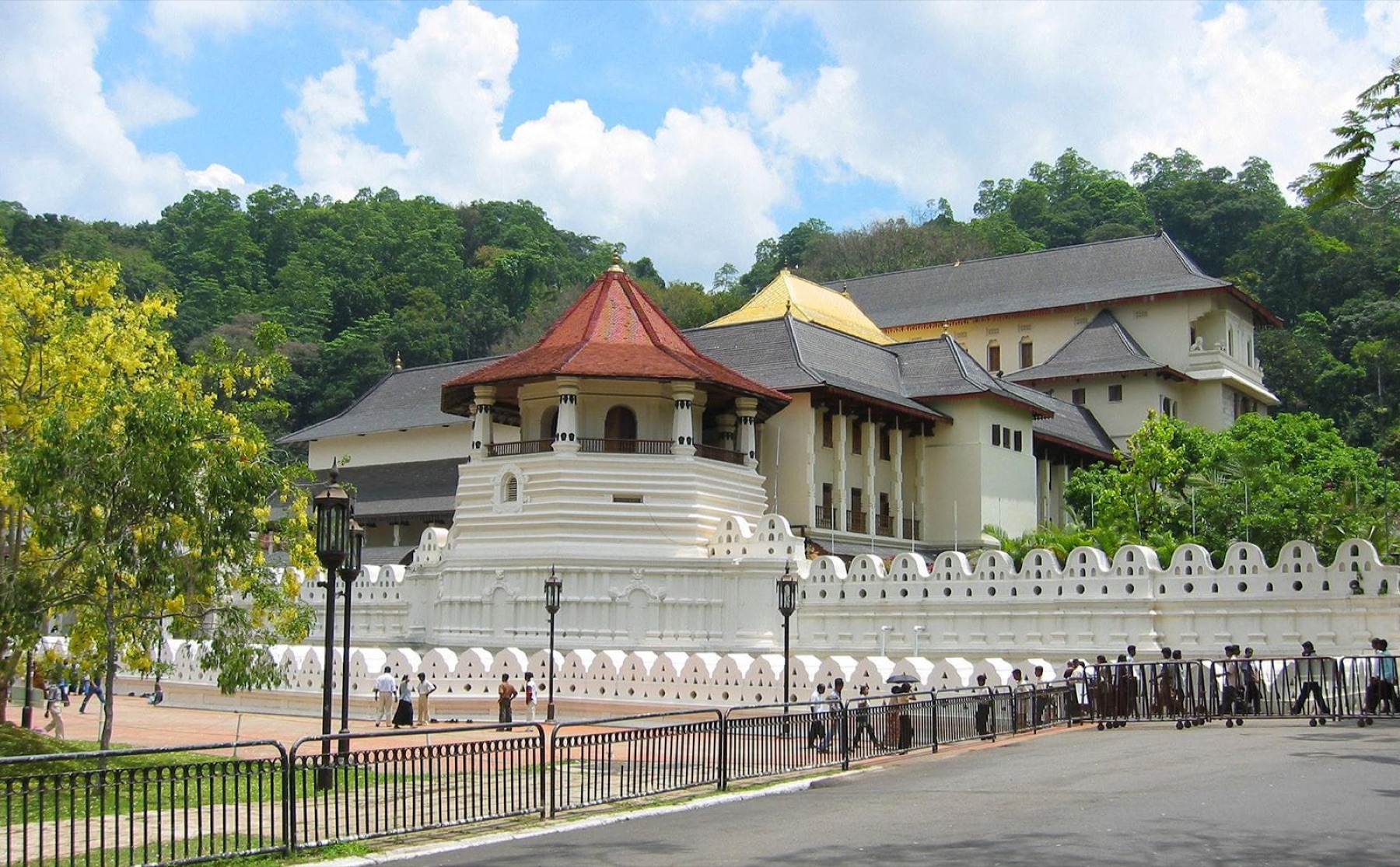
Kandy is where Sri Lanka kept its independence the longest. While the coast fell first to the Portuguese, then the Dutch, the kings of Kandy held out in their ring of hills until 1815, when the British finally took the highlands — making it the last royal capital of the Sinhalese kingdom. That history is why Kandy still feels like the cultural and spiritual heart of the island, and why it’s one of the places I most enjoy bringing people who want to understand the country rather than just photograph it.
At the centre of everything is the Temple of the Sacred Tooth Relic — Sri Dalada Maligawa — which enshrines a tooth of the Buddha himself. The relic has been a symbol of sovereignty for over a thousand years; tradition held that whoever guarded the tooth held the right to rule. You don’t see the tooth itself — it sits within a series of golden caskets, one inside the next — but you join the river of pilgrims, white-clad and carrying lotus flowers and frangipani, as the casket chamber is opened. It’s a working temple, not a museum, and that’s exactly what makes it move people.
I time our arrival for the evening puja, the ceremony held around half past six, when drummers and horn players fill the temple with sound and the inner chamber is opened to view. The morning and midday pujas are quieter; the evening one is the most atmospheric, and arriving an hour before lets us walk the temple’s painted halls and the moonstone thresholds without rushing. There’s a modest dress code — shoulders and knees covered, shoes removed at the entrance — and I’ll always tell you in advance so you’re dressed right and not turned away at the gate.
The temple sits on the edge of Kandy Lake, an artificial lake built in 1807 by the last king of Kandy, Sri Wickrama Rajasinha — the same king the British would depose eight years later. A walk around its shore is one of the gentlest, loveliest things to do in Kandy: monitor lizards basking, pelicans on the water, and the white parapet the locals call the “cloud wall” running along the lakefront. In the late afternoon, before the puja, it’s a perfect way to slow the day down.
If you have an evening to spare, I’ll take you to a Kandyan dance performance — the drumming, the acrobatic leaps, the fire-walking finale are a genuine local tradition, not a tourist invention, and they end most nights in town. And just outside Kandy lie the Royal Botanical Gardens at Peradeniya, 60 hectares of giant bamboo, an avenue of royal palms, and an orchid house — a calm, green morning that pairs beautifully with the intensity of the temple.
The single biggest thing to know about Kandy is the Esala Perahera. For ten nights in July or August, the city stages one of Asia’s great processions: a casket symbolising the sacred tooth carried on a tusked elephant draped in lights, escorted by hundreds of dancers, drummers, whip-crackers and torch-bearers through streets packed many deep. It is extraordinary — and it means the city fills completely. If you want to be here for it, tell me early; the dates shift with the lunar calendar each year, hotels book out months ahead, and a decent roadside vantage point for the procession has to be arranged well in advance.
On the practical side, Kandy is an easy drive within the classic loop. From Sigiriya and the Cultural Triangle it’s only about 95 kilometres, two-and-a-half to three hours, so there’s comfortably room in the day for both the temple and the lake, or the gardens. Coming up from Colombo, the new Kandy Expressway (E03) has cut what used to be a long, winding slog into a far quicker run, and I use it whenever it saves you time. The town itself is hilly and the traffic around the lake can be slow at peak hours, which is one more reason to have someone else doing the driving and the parking while you simply walk in.
From the driver’s seat: dress for the temple before we set off so you’re not buying a sarong at the gate; the evening puja is the one to aim for; and if you’re even loosely near the Esala dates, build the trip around them rather than hoping to squeeze it in. Kandy rewards an unhurried evening — the temple, then the lake at dusk, then dinner above the lights of the town.
Read on: the North & East · all guides